
Stable performance
Stable equipment performance.
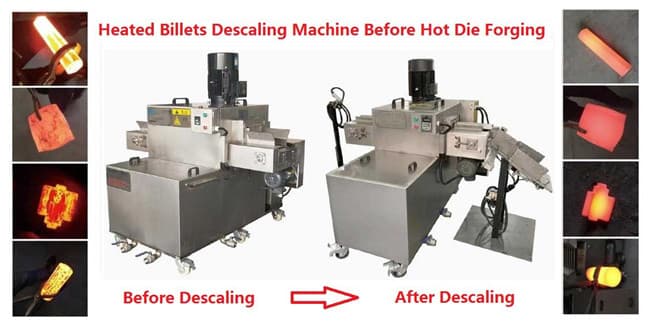
Removes oxide scale from red-hot forged billets before die forging, using adjustable scrapers and torsion springs, preventing surface pitting and improving part quality.
Overview
In the forging production process, the metal blank needs to be heated to high temperature and steel reacts with oxygen on the billet surface, which generates a layer of scale. If it cannot be removed before forging production, some pits may occur on the surface, which not only affect the appearance quality but also reduce local strength.
Two approaches exist: (1) tapping on the forging equipment and using metal deformation to remove the scale, and (2) a scale removal device, where the scale generated on the billet surface during the heating process is removed before forging production.
Key data
Full technical parameters are confirmed together with our engineers, based on your part and production volume.
Features
Stable equipment performance.
Long service life.
Reduces the labour intensity of the operator.
Good effect of removing scale and fast speed.
Automation working, and connecting with a forging production line is easy.
The device uses position adjustment bolts and scraper replacement to adapt to various blank shapes and sizes, and replacement of the preset torsion spring for different materials.
In use
Gallery
Video
| Parameter | Unit | AY-09-X | AY-09-D | AY-09-D-S | AY-09-X-W | AY-09-D-W | AY-09-X-D | AY-09-D-D |
|---|---|---|---|---|---|---|---|---|
| Version | — | Small descaling machine | Big descaling machine | Double pumps big descaling machine | Temperature control small descaling machine | Temperature control big descaling machine | Position small descaling machine | Position big descaling machine |
| Pressure | MPa | 1,5–1,7 | 1,5–1,7 | 2,5–3,0 | 1,5–1,7 | 1,5–1,7 | 1,5–1,7 | 1,5–1,7 |
| Voltage | V | 380 | 380 | 380 | 380 | 380 | 380 | 380 |
| Material | — | SS304 | SS304 | SS304 | SS304 | SS304 | SS304 | SS304 |
| Round bar — diameter | mm | φ20–φ80 | φ55–φ100 | φ55–φ100 | φ20–φ80 | φ55–φ100 | φ20–φ80 | φ55–φ100 |
| Round bar — length | mm | ≤400 | ≤500 | ≤500 | ≤400 | ≤500 | ≤400 | ≤500 |
| Blank after cutting — width × height | mm | ≤110×80 | ≤160×100 | ≤160×100 | ≤60×55 | ≤160×100 | ≤60×55 | ≤160×100 |
| Blank after cutting — length | mm | ≤400 | ≤500 | ≤500 | ≤400 | ≤500 | ≤400 | ≤500 |
| Chain bearing | kg | 15 | 30 | 30 | 15 | 30 | 15 | 30 |
| Dimensions (L × W × H) | mm | 1300×1500×1500 | 1600×1600×1600 | 1600×1800×1600 | 1300×1500×1500 | 1600×1600×1600 | 1300×1500×1500 | 1600×1600×1600 |
* Specifications shown correspond to the reference model in each series and may vary by configuration.
Advantages
From billet handling and ring rolling to shearing, descaling and final pressing — 15 distinct machines cover virtually every complementary stage of the forging workflow.
01Every machine is designed to run standalone or integrated, alongside Anyang CNC hammers and presses, into fully automated production lines.
02Technologies such as ring rolling and cross wedge rolling reduce material waste and improve dimensional accuracy compared with conventional cutting or free-forging methods.
03Welded steel frames, PLC/CNC control and reliable hydraulic or pneumatic systems, built for continuous, multi-shift operation.
04See also
 D53K
D53K D51
D51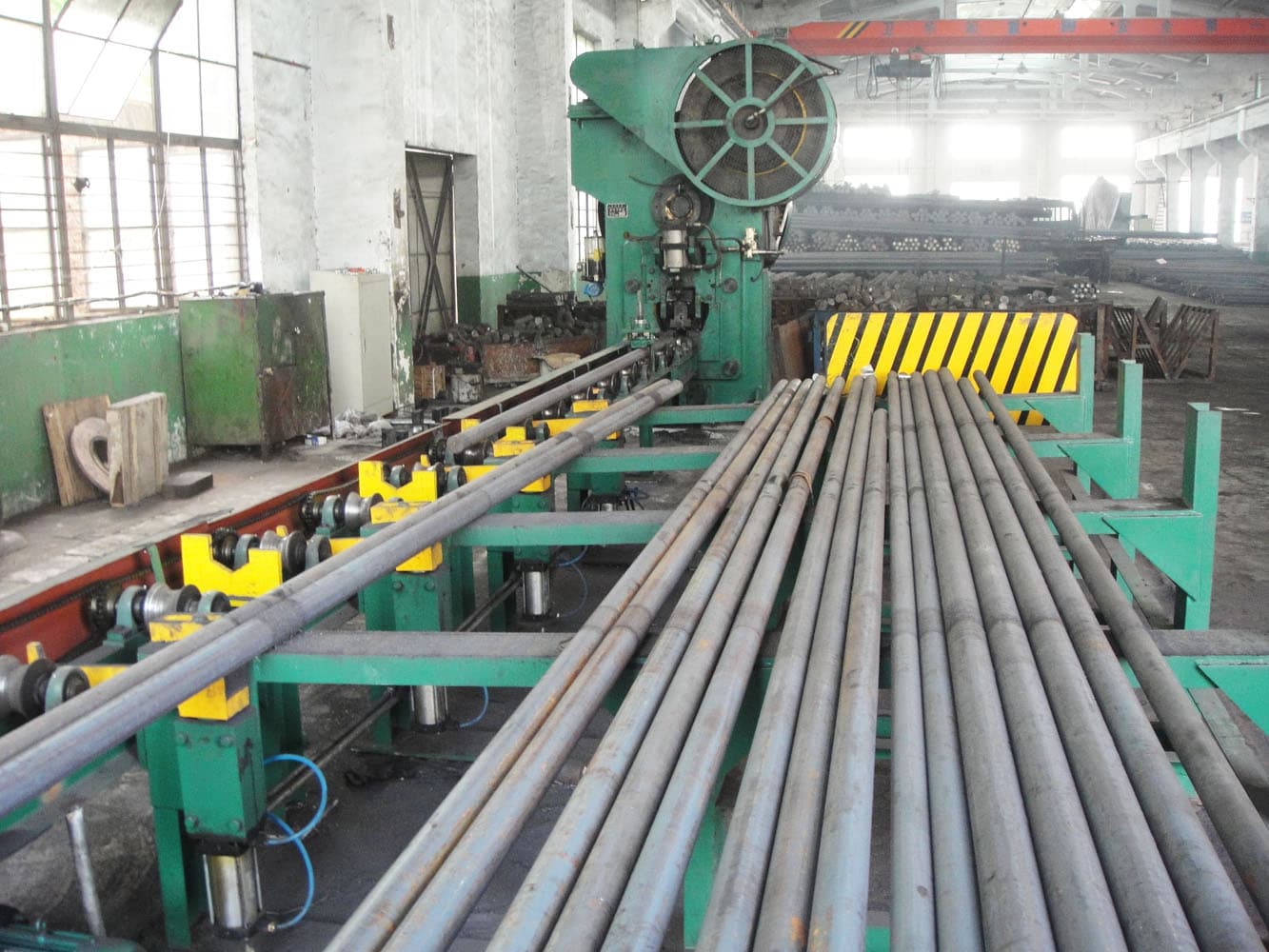
 WGP
WGP JH21
JH21 ZGD
ZGD
 JW31
JW31 JS31
JS31 X-Q45
X-Q45 WP
WPOur technical team helps you identify the right equipment from this extensive portfolio, for any stage of your forging workflow.